









What Goes With Grenache?
Grenache is one of those grapes that can show up in more places than you might realize. You can find it on its own, playing a major role in some very well-known blends, and yes, in plenty of rosé too. So when we’re talking about what to eat with Grenache, there isn’t really one plate that answers the question.
As a red, Grenache tends to bring plenty of ripe red fruit, warmth and spice without the heavy tannins we get from some bigger reds. That can make it surprisingly flexible with food. Turn it into rosé, however, and we’re working with something fresher and lighter at the table. And once Syrah and Mourvèdre enter the picture? Well, now we’re getting into another pairing conversation entirely — and we’ll save the blends for their own article.
Getting to Know Grenache
Grenache can be a little deceptive in the glass. Its color is often lighter ruby to medium red rather than deeply opaque, especially compared with grapes like Syrah or Cabernet Sauvignon. But lighter color doesn’t necessarily mean a light wine. Grenache thrives in warm climates and can produce wines with plenty of ripe fruit, body and fairly generous alcohol.
Tannins tend to sit on the softer to moderate side. Think less grip than Cabernet Sauvignon and generally less structure than Syrah. That softer tannin profile is part of what makes Grenache so approachable with food: there are fewer pairings where the wine suddenly feels like it’s fighting what’s on the plate.
Flavor-wise, strawberry, raspberry and cherry are common territory, often joined by dried herbs, pepper, spice and sometimes a slightly earthy character. Where it’s grown matters, of course. Grenache is closely associated with Southern France—particularly the Southern Rhône—as well as Spain, where you’ll see it as Garnacha. It’s also grown in places including Australia and California.
And Grenache doesn’t always arrive alone. It’s a major blending grape, particularly alongside Syrah and Mourvèdre. We’ll get into those blends separately because once the other grapes join the party, the pairing possibilities start changing too.
Why Grenache Works With Food
Here’s where Grenache gets fun. It has enough fruit and body to stand beside flavorful dishes, but its generally softer tannins mean we don’t necessarily need a huge piece of steak just to keep the wine happy.
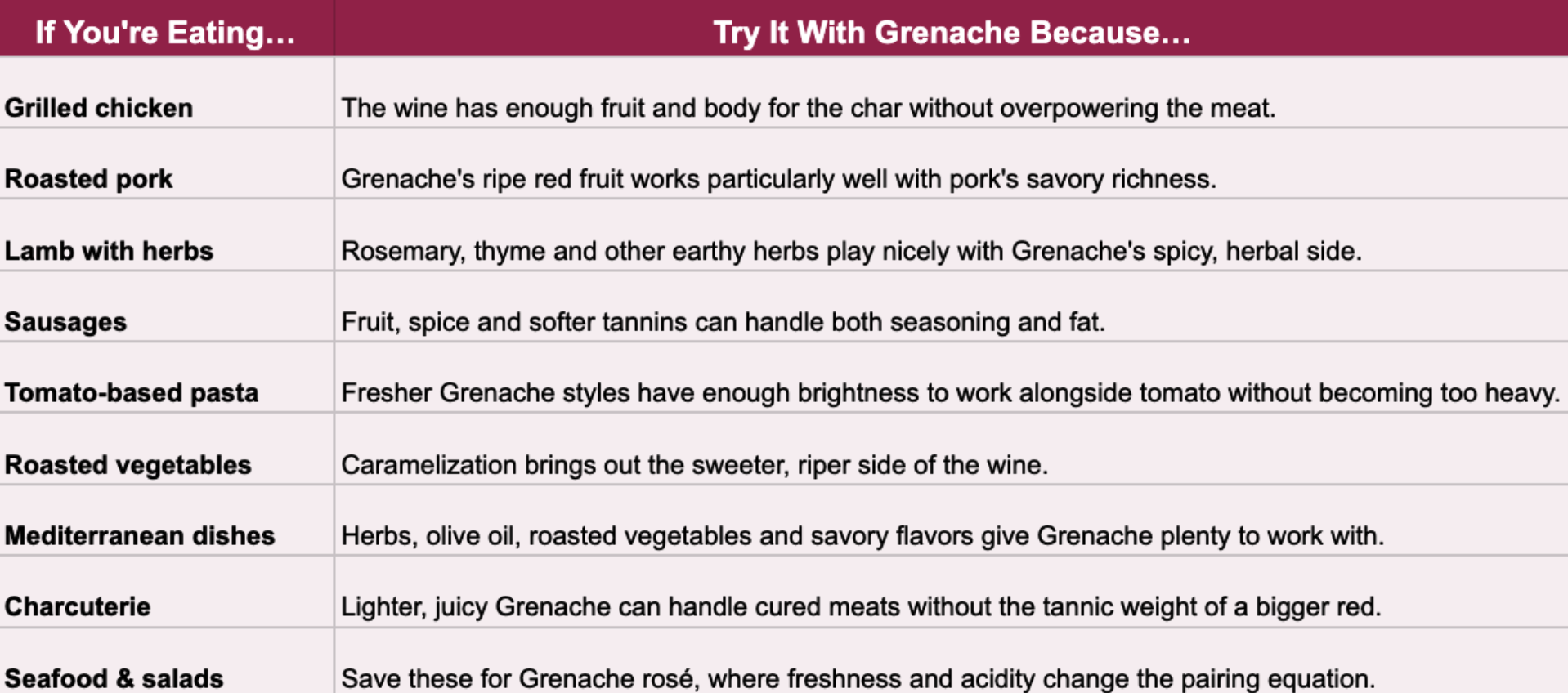
The ripe red fruit works particularly well with roasted and grilled flavors, while Grenache’s herbal and spicy side makes it a natural match for dishes involving rosemary, thyme, pepper and Mediterranean-style seasonings. Depending on the bottle, there can also be enough richness to handle slightly sweeter or smoky elements without completely overwhelming them.
A simple way to start thinking about it is:
Ripe + Fruit-Forward Grenache → Red Fruit, Warmth & Softer Tannins → Roasted Pork, Grilled Chicken, Mediterranean Dishes & Roasted Vegetables
But Grenache isn’t one fixed style. A fresher, lighter bottle and a ripe, higher-alcohol Grenache from a warmer region aren’t necessarily asking for the same dinner. That’s where the pairing gets a little more interesting.
Not All Grenache Shows Up the Same Way
Grenache can move from bright and juicy to considerably richer depending on where it’s grown and how it’s made. A fresher style can lean heavily into strawberry, raspberry and herbs, while warmer-climate or riper expressions can bring more body, alcohol, darker fruit and even a slightly jammy quality. That difference matters at the table—a Grenache that feels lively and fruit-forward doesn’t necessarily need the same food as one carrying considerably more weight.
Here’s an easy way to think about the shift:
Fresh + Juicy Grenache → Bright Red Fruit, Herbs & Softer Structure → Charcuterie, Grilled Chicken, Tomato-Based Dishes & Vegetables
Ripe + Fuller Grenache → Richer Fruit, Warmth & More Body → Pork, Lamb, Sausages, Roasted Meats & Hearty Mediterranean Dishes
Neither is necessarily the “better” Grenache. They’re simply giving us different things to work with—which is exactly why looking at the style of the wine can be more useful for pairing than looking at the grape name alone.
And Yes, Grenache Can Be Rosé Too
Grenache also happens to be an important grape for rosé, and this is where the pairing conversation changes a bit. With much less extraction from the skins, we’re no longer relying on the body and tannin of red Grenache in quite the same way. Freshness and acidity become much more important, which is why Grenache rosé can suddenly feel at home beside foods that we haven’t talked about much with the red wine.
Dry + Fresh Grenache Rosé → Red Fruit, Acidity & Palate-Cleansing Freshness → Seafood, Salads, Mediterranean Dishes & Lighter Pasta
That doesn’t mean every Grenache rosé tastes alike, of course. But it does show why simply knowing the grape isn’t always enough: same Grenache, very different pairing logic.
If you want to go further into how rosé styles change what works on the plate, our Rosé Food Pairing Guide breaks that down by style—from crisp and high-acid to richer, more structured rosés.
So, What Should We Actually Eat With Grenache?
Grenache gives us quite a bit of room at the table. Its fruit can complement savory and slightly sweet flavors, its spice works beautifully with herbs and seasoning, and its generally softer tannins mean we don’t always need a particularly fatty or protein-heavy dish to balance the wine.